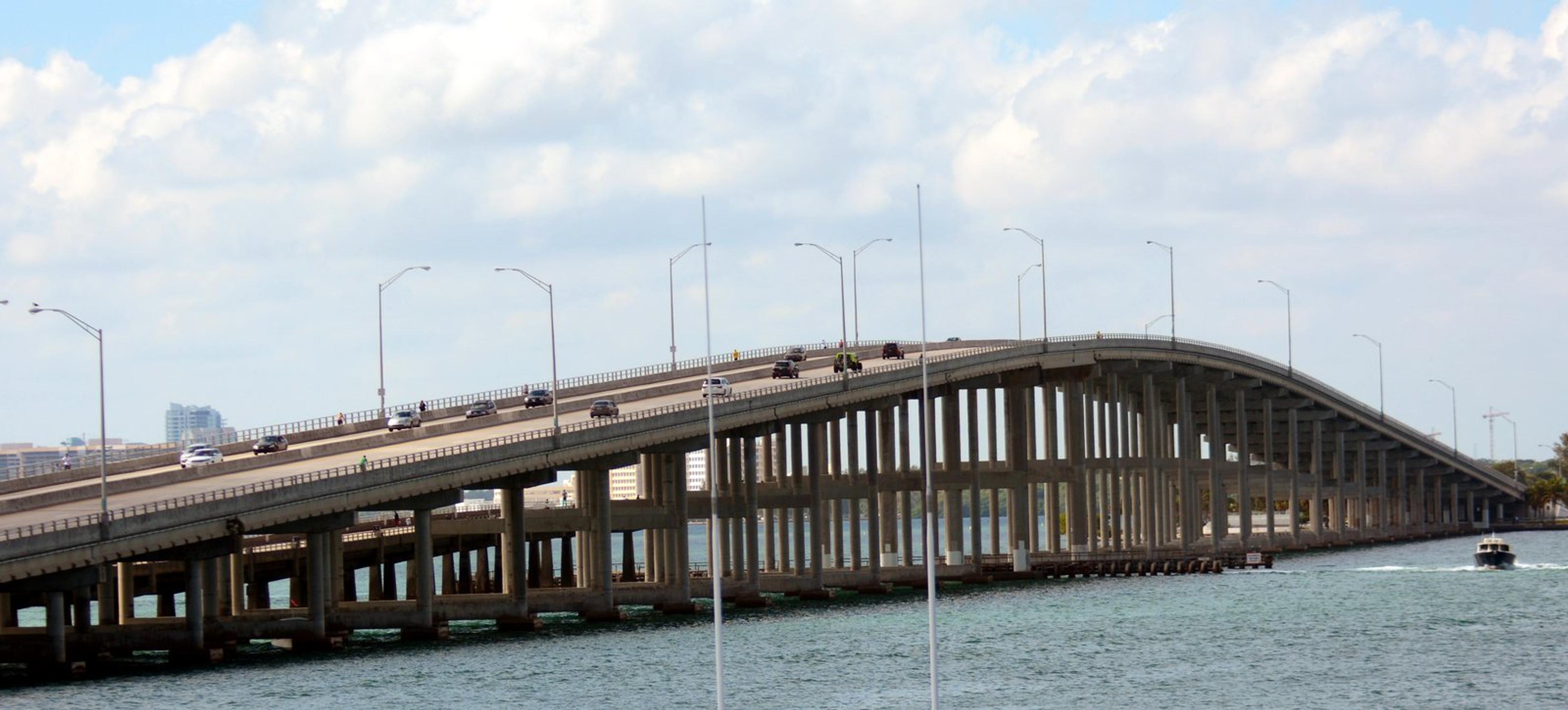
Miami-Dade approves Bear Cut Bridge study agreement with FDOT
The agreement preserves federal funding eligibility as the county studies repair, rehabilitation and replacement options. The review is expected to finish in March 2027, with design following afterward.
Key Takeaways
- •The county adopted the study agreement on October 6; it does not select a construction alternative.
- •Rickenbacker Causeway toll revenues fully fund the environmental study.
- •The county expects the study to finish in March 2027, before design begins.
Miami-Dade County has approved an agreement with the Florida Department of Transportation for the environmental study guiding the future of Bear Cut Bridge, the only mainland road connection to Key Biscayne. The October 6 action formalizes how the agencies will carry out the review while preserving eligibility for future federal funding.
The adopted resolution, R-814-26, authorizes the county mayor or a designee to execute the memorandum. It advances the planning process for a bridge that serves residents, workers, visitors and emergency operations along the Rickenbacker Causeway. A rehabilitation or replacement option has yet to be selected.
The county's Department of Transportation and Public Works will conduct the Project Development and Environment study, commonly called PD&E. The state transportation department will provide oversight and technical guidance under the federal environmental review framework. County bridge engineering manager Ryan Fisher is identified in the accompanying memorandum as overseeing the agreement and study.
According to the county project page, the study began in October 2024 and is expected to finish in March 2027. Design would follow completion. Its 1.1-mile corridor runs from Arthur Lamb Jr. Road to Crandon Marina Access Road, linking the Virginia Key and Key Biscayne sides of the crossing.
The alternatives include repair, major rehabilitation and replacement. Engineers will also consider parallel alignments, different bridge elevations and structure types, wider shoulders, and improved bicycle and pedestrian facilities. The choices will be evaluated through engineering, environmental and community review, giving the study a broader scope than the bridge's structural components alone.
Miami Today reported on October 14 that county transportation director Stacy Miller told commissioners the agreement commits the county to the study process. The newspaper also reported her explanation that the bridge remained safe despite its deterioration and structural deficiencies. That distinction matters for users following a long-term improvement project while continuing to rely on the existing crossing.
The county's project history describes a bridge first built in 1944 and widened in 1983. It says a 2023 repair project addressed concrete, piles, bearings and other structural concerns, avoiding load restrictions that had been recommended after an earlier inspection. Those repairs preceded the current review of longer-term options.
Funding decisions will continue beyond the study. The county memorandum says executing the agreement creates no immediate fiscal impact, and that Rickenbacker Causeway toll revenues fully fund the PD&E work. Costs associated with implementing future environmental commitments remain undetermined until the review is completed.
For Key Biscayne, the access question extends beyond daily commuting. The official project overview identifies the bridge as a designated emergency evacuation route. Maintaining the crossing also supports people traveling for work and recreation, making the eventual choice of an alternative consequential across several kinds of trips.
The next stated milestone is the study's expected March 2027 completion, with public involvement continuing during its development. Miami Today reported that no clear timetable for subsequent bridge work has been established. The practical items to watch are the preferred alternative, environmental commitments and the later design and funding decisions. Public feedback remains part of that selection process.
Photograph by Don Ramey Logan: Rickenbacker Causeway bridge photo Don Ramey Logan.jpg / Wikimedia Commons. Resized and color-adjusted photo: CC BY-SA 4.0.