FAU receives $400,000 NSF grant for post-quantum security research
The Boca Raton university says the award will support advanced cryptographic protocols and student research. The project examines security functions beyond basic encryption and signatures, with efficiency, scalability and mathematical security proofs among its priorities.
Key Takeaways
- •FAU reports a $400,000 National Science Foundation award for advanced post-quantum cryptographic protocols.
- •Edoardo Persichetti leads the project, with Veronika Kuchta as co-principal investigator.
- •The work includes student mentoring and outreach; the announcement does not state a project period or commercial deployment date.
Florida Atlantic University says it has received a $400,000 National Science Foundation grant to develop post-quantum cryptographic protocols, extending its research into security functions beyond basic encryption and digital signatures.
The October 19 announcement identifies Edoardo Persichetti as principal investigator and Veronika Kuchta as co-principal investigator. Both work in FAU's Department of Mathematics and Statistics within the Charles E. Schmidt College of Science. Persichetti also directs the university's Center for Cryptology and Information Security.
The project will investigate blind signatures, threshold signatures, multisignatures and verifiable random functions. FAU describes the work as mathematical research supporting more sophisticated security applications, including decentralized systems and technologies intended to preserve privacy.
Security beyond a single signature
These functions address different questions about trust in digital systems. A threshold signature distributes the signing operation among multiple participants, rather than relying on a single party to carry out the entire process. Research on such designs examines how shared signing can operate in a post-quantum setting.
A verifiable random function allows a secret-key holder to produce a cryptographic output accompanied by proof that others can check using the corresponding public key. The output is deterministic for a given key and input. This combines controlled computation with public verification, rather than asking users simply to trust whoever produced the result.
The published technical specifications for these functions describe existing constructions. They help explain the functions FAU plans to study; they are not evidence that the new project has already produced quantum-resistant versions.
FAU says its researchers will develop and analyze protocols using mathematical frameworks including lattices, error-correcting codes and group actions. The work includes rigorous security proofs based on specified computational assumptions, with efficiency and scalability among the research priorities.
Preparing for future computing
The National Institute of Standards and Technology, or NIST, describes post-quantum cryptography as protection designed to resist attacks from both conventional and future quantum computers. Sufficiently capable quantum machines could undermine important mathematical problems used in current public-key systems.
NIST says the timing of a machine capable of threatening present-day cryptography remains unknown, with substantial technical hurdles still to overcome. The reason to prepare early is that integrating new cryptographic methods into products and information systems can take many years.
The agency released its first three finalized post-quantum cryptography standards in 2024. Those standards provide a broader backdrop for research into additional capabilities, but FAU's newly announced grant is a separate research award. It does not establish that a finished product or new standard has emerged from this project.
For Boca Raton's research community, the award also brings a training component. FAU says the work will support student mentoring through research experiences and outreach, connecting mathematical investigation with preparation of future cryptography and cybersecurity researchers.
The university's announcement gives no project duration, award start date or annual funding schedule. It also provides no projected number of jobs or quantified commercial impact. The immediate milestone is funding for the research team and its proposed work; later evidence of progress would come from the protocols, security analyses and student research activities the project produces.
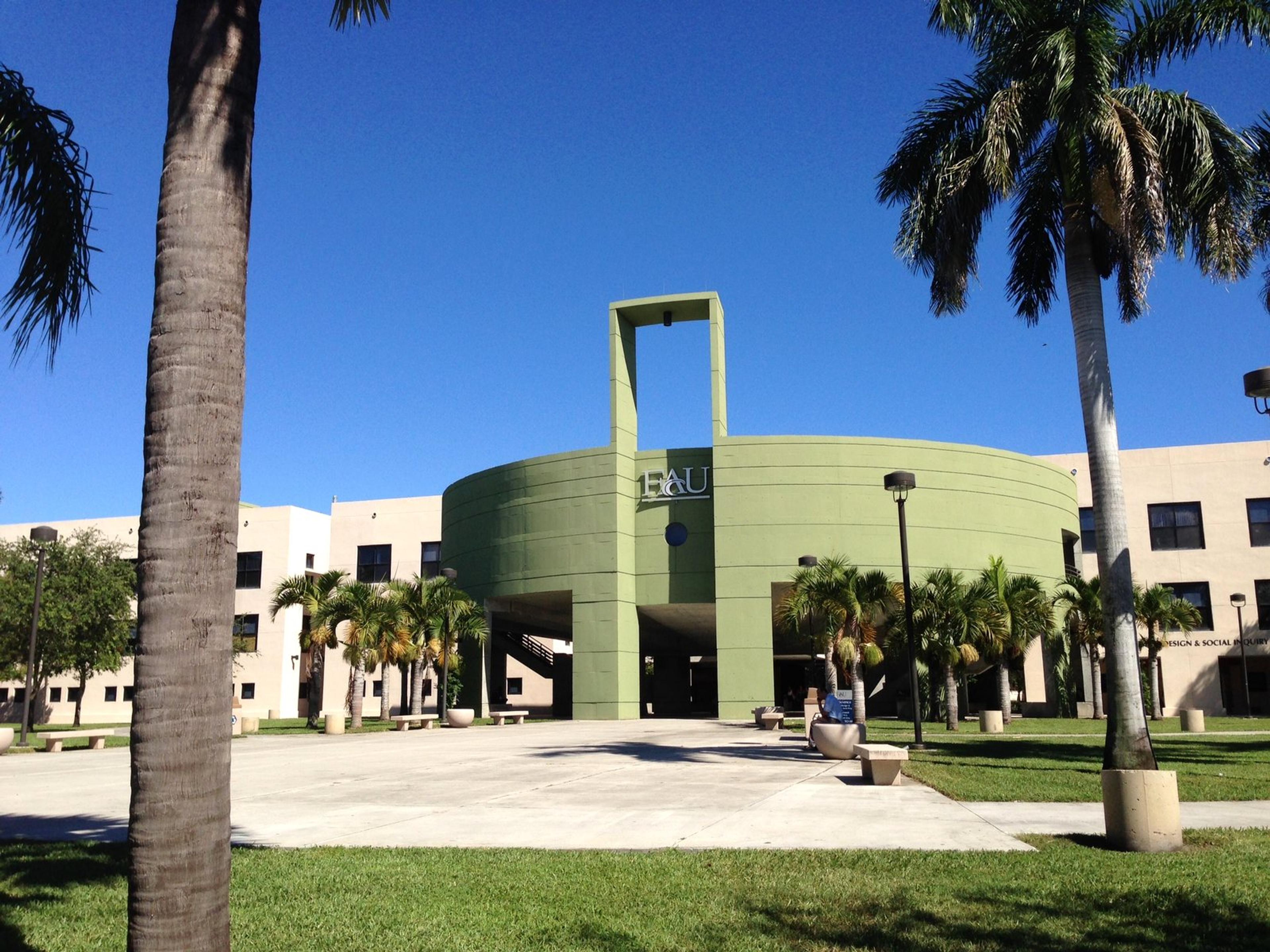
Photo: FAU Social Science Building by Kmgcoolguy4, via Wikimedia Commons. Resized and lightly tone-adjusted. Licensed CC BY-SA 3.0.