Ken Griffin's Miami Bet
Key Takeaways
- •On September 30, 2026, Carnegie Mellon announced a $3bn gift from Ken Griffin — $2bn toward a planned Wynwood campus, $1bn to Pittsburgh. The campus is still planned, not open.
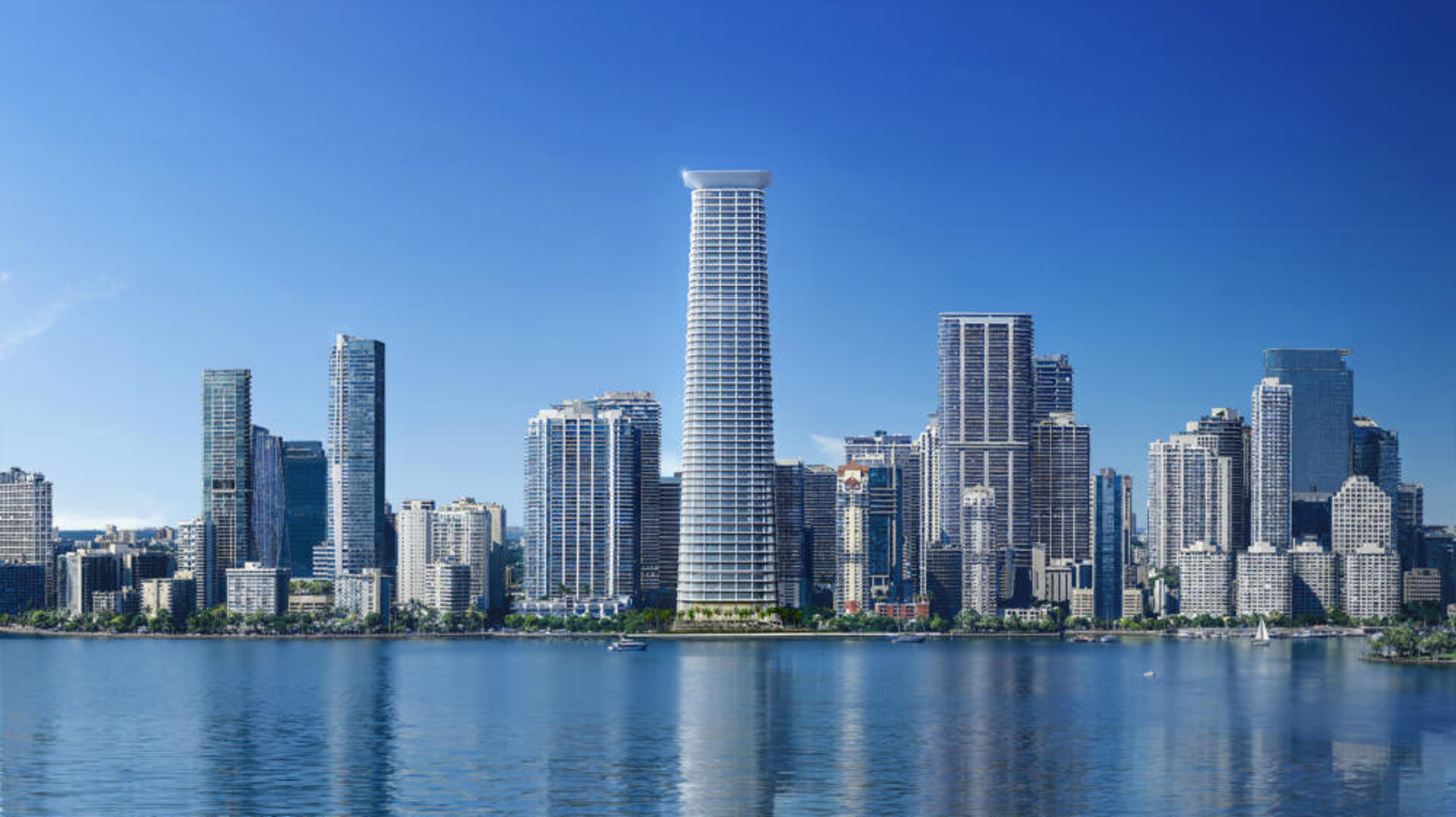
- •Citadel’s Miami global headquarters (since 2022) is at 830 Brickell Plaza; the waterfront tower at 1201 Brickell Bay Drive is a separate project still in delivery — a stop-work order was reported in September 2026.
- •The clearest early evidence is in medicine: three announced health-care gifts total $125m (Nicklaus $25m, Sylvester $50m, Baptist $50m), and the Griffin Cancer Research Building opened in 2025.
- •County records show proposed public-benefit terms (a $3m transportation contribution, a pump-station obligation capped at $13m, two crossings) — proposed triggers, not confirmed payments or completed works.
- •Region-wide metrics (214,900 metro financial-activities jobs, down 2.7% year over year; Biscayne Bay monitoring) describe the area, not Citadel’s individual effect. The real test is whether these institutions reinforce one another.
A headquarters in Brickell. A university planned for Wynwood. Hospitals expanding their research. The real story is how these investments might connect.
Citadel’s headquarters move establishes a Miami base.2
Three selected health-care gift announcements, 2023–2024. See the calculation.
Miami allocation within the 2026 CMU gift. Campus remains planned.8
Miami’s most consequential new address may not belong to an office tower. On September 30, 2026, Carnegie Mellon University announced a $3 billion gift from Ken Griffin, with $2 billion allocated to establishing a campus in Wynwood and $1 billion to Pittsburgh. Four years after Citadel’s headquarters move, Griffin’s commitment to the city had acquired a different scale and a different purpose.8
The tower still matters. Citadel lists its current global headquarters at 830 Brickell Plaza, while its future waterfront workplace is planned for 1201 Brickell Bay Drive. Those are two different addresses and two different stages of the story.13
To understand what this means for Miami, follow the connections between the buildings: the people a financial firm recruits, the research a university supports, the care a hospital can offer, and the streets and public spaces that allow those institutions to function. That is where a corporate relocation can become something more durable. It is also where the difference between a promise and a result becomes visible.
01
Two firms, one consequential move
Ken Griffin founded Citadel in 1990. Citadel and Citadel Securities are separate businesses: the former is an investment firm; the latter is a market maker that provides liquidity in financial markets. Combining their names into a single company obscures what each actually does. Citadel’s corporate history dates the establishment of its Miami global headquarters to 2022.2
For a city, a headquarters carries a particular kind of possibility. Senior teams make decisions there, professional relationships can form around them, and suppliers have a reason to maintain a local presence. Lawyers, accountants, engineers and technology specialists may find new clients. Those are channels through which a relocation can matter, rather than a calculation of how much this one has already contributed.
The evidence needs to stay at the right scale. In June 2026, Bisnow reported approximately 500 employees at Citadel’s current Miami headquarters and attributed a plan for Citadel and Citadel Securities to occupy roughly 561,000 square feet in the future tower to chief workplace officer Paul Darrah. These are a reported headcount and an intended occupancy figure. Neither establishes a future job total.4
A useful measure of success would follow local hiring, supplier spending and employee retention over time. Floor area cannot answer those questions on its own. Nor can an announcement establish how many opportunities will go to people who already live in Miami.
The sequence
From relocation to institutions
- 2022
Citadel establishes its global headquarters in Miami.2
- Jan 2023
Nicklaus Children’s announces a $25m gift.12
- Mar 2024
- Aug 2024
Citadel publishes waterfront tower renderings.3
- Dec 2025
County packet examines development and proposed public benefits.5
- Jun 2026
Darrah describes intended tower occupancy.4
- Sep 2026
County stop-work order reported; CMU announces the gift and campus plan.78
Milestones of different kinds. This is not a cumulative investment or impact series.
02
A tower whose story has changed
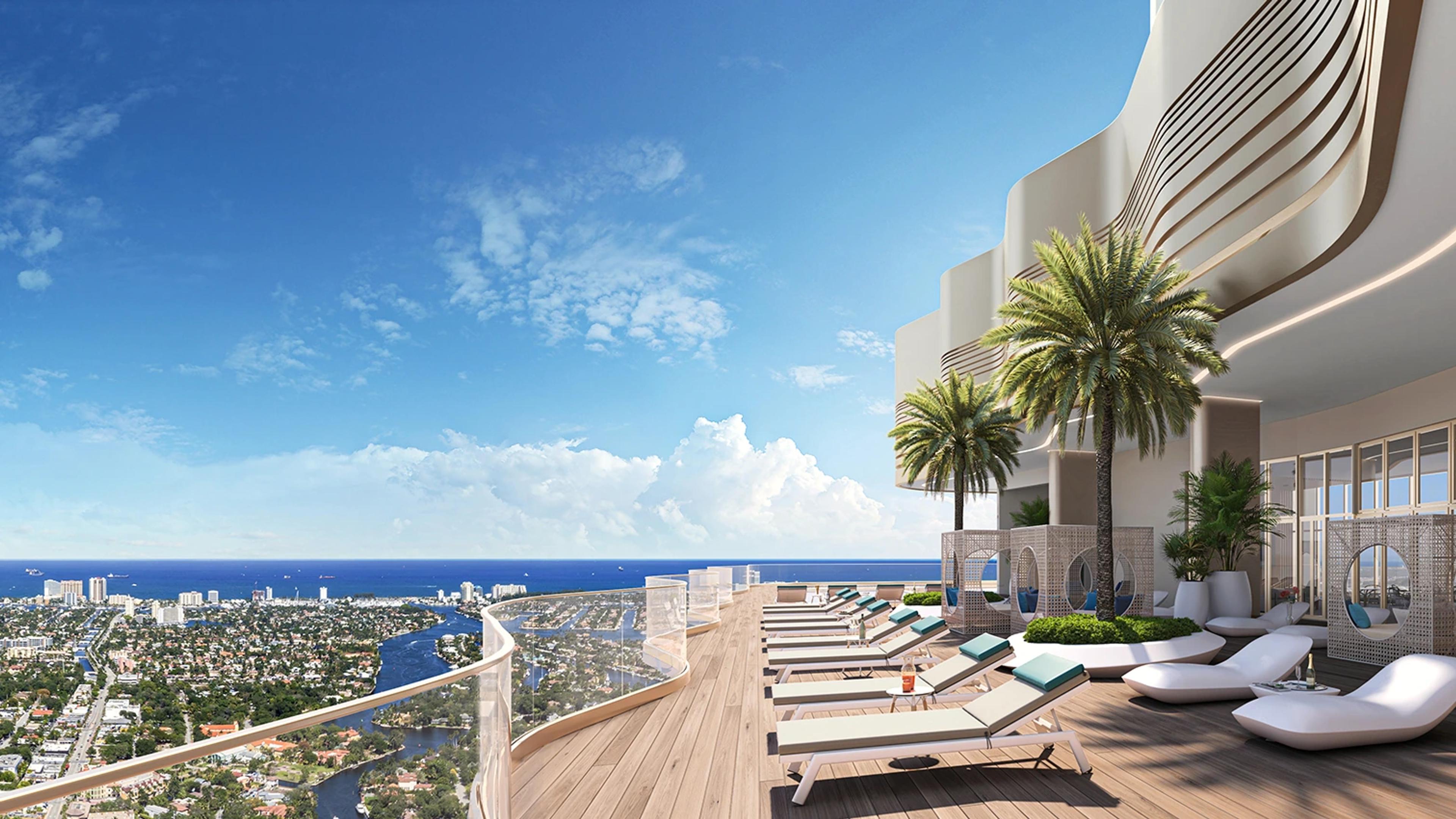
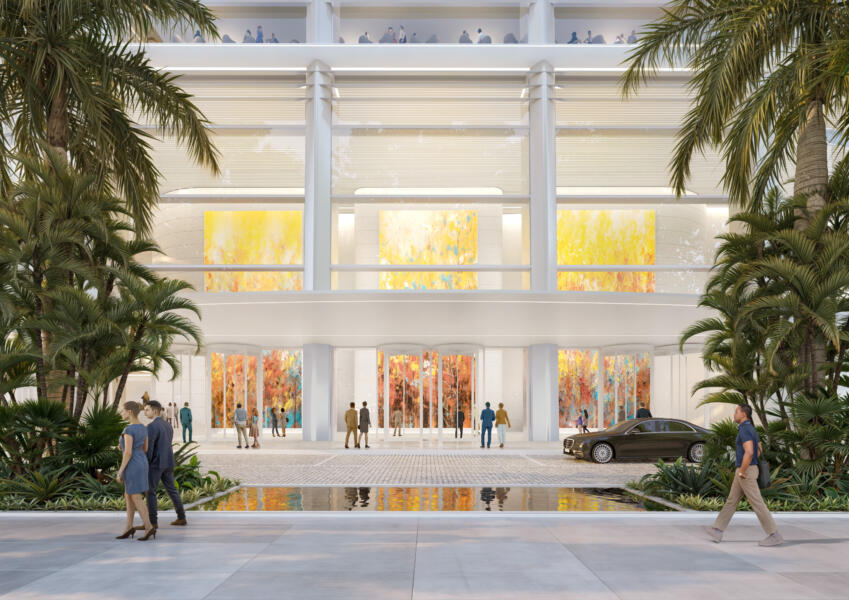
The August 2024 images released by Citadel made the waterfront project tangible: a rounded tower, a broad crown and an arrival sequence on Brickell Bay Drive. They remain valuable historical illustrations. They should be read with their date attached.3
By July 2026, Florida YIMBY’s account of a new shoreline submission described a 52-story office scheme with about 1.712 million square feet of floor area. Its office allocation included support and storage space. The account described a public baywalk and an elevated public terrace, while June reporting had already identified the removal of the hotel from the main tower. These are later descriptions of a developing proposal, not evidence that the completed building will match every published image.64
Even current numbers require care. Citadel’s own Miami page describes 1.2 million square feet of office space and tenant amenities, while planning coverage uses larger floor-area figures. Those descriptions do not define the same measurement. This report does not calculate an occupancy percentage across them.16
The construction timetable also needs a dated qualification. On September 21, 2026, Bisnow reported that Miami-Dade had issued a stop-work order following the September 14 drilling-rig collapse. County spokesperson Tere Florin told the publication that reopening required submission and approval of a safety plan. A subsequent lifting order was not independently verified for this report. The cause and duration should not be inferred from the incident.7
The practical conclusion is straightforward: Miami already has the headquarters operation; the new waterfront building remains a delivery project. Its future opening should not be treated as a completed economic event.
03
The public record reaches beyond the property line
The most revealing pages are in the December 18, 2025 county zoning packet. Staff recommended approval with conditions for application Z24-188, following deferrals in October and November. The review linked development rights to the Metromover subzone and considered a shoreline setback of 40 feet against a 50-foot requirement.5
The proposed declaration separated a $3 million transportation contribution from a pump-station obligation capped at $13 million, excluding preparation of the drainage plan. The transportation contribution was tied to a vertical building permit. The pump provision depended on city approvals, funding for connected works and permits, with release provisions if milestones were not met. Two crossings and an additional crossing analysis were also proposed. These are terms in the packet, not independently confirmed payments, completed works or an executed final covenant.5
That distinction changes how the project should be assessed. A drainage installation only becomes useful when it connects to a working system. A crossing must be safe and accessible in practice. A payment needs a traceable receipt and an account of what it funds. The public value lies in delivery, maintenance and access over time.
The transit connection is a particularly concrete opportunity. Miami-Dade operates Metromover as a free service through downtown, Omni and Brickell and is upgrading its equipment for reliability. For employees and residents alike, station access and dependable service are part of the usefulness of a dense business district.17
The waterfront deserves the same attention. A public route should feel public at street level, with legible entrances, accessible connections and a clear relationship to adjoining paths. The right question is how comfortably a person can use it on an ordinary afternoon, including someone with no business inside the tower.
Inside the county packet
Different obligations. Different triggers.
| Provision | Trigger or qualification |
|---|---|
| $3m transportation contribution | Before a vertical construction building permit. |
| Pump station: up to $13m | Conditional on approvals, connected-system funding and permits; release provisions apply. |
| Two crossings | Occupancy-related provision with government-delay qualifications. |
Original PDF pp. 214-220. The pump amount is a cap, not a paid donation or an estimate of total drainage-system cost.5
04
Wynwood adds a different kind of institution
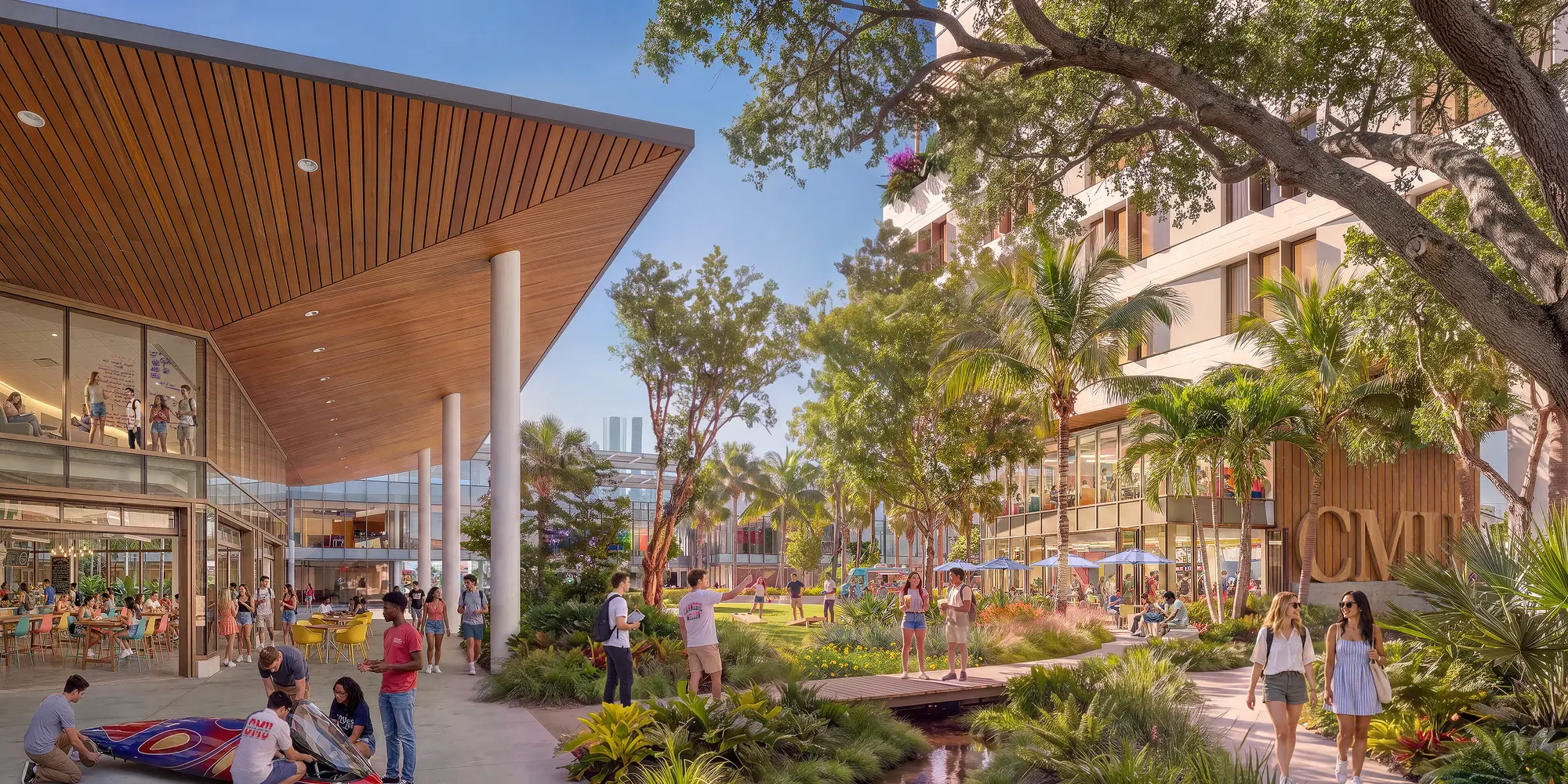
The Carnegie Mellon announcement is significant because a university can produce knowledge and talent locally, year after year. The planned Miami campus, led by the university under president Farnam Jahanian, connects Griffin’s business presence to an institution with a separate educational mission. The announced gift is personal philanthropy, not Citadel payroll or a municipal capital budget.8
The university’s project page describes a 35-acre campus, eventually supporting more than 3,500 students, nearly 300 faculty and over 600 staff. Construction is slated for 2027, with the first graduate students expected in 2028, subject to regulatory approvals. Those are targets for a future institution, not people already studying or working in Wynwood.9
The plan includes research on health, national security, energy and climate resilience, and advanced manufacturing. Space for industry research laboratories and venture studios is also envisaged. The ambition extends beyond supplying employees to a single financial firm.8
For Miami, the interesting test will be the relationships that develop around the campus. Can local students access the opportunities? Can researchers work with hospitals, public agencies and businesses elsewhere in the region? Can new ventures find the people and facilities needed to stay? A campus can make those connections easier, but a rendering cannot demonstrate that they exist.
Wynwood will also need to work as a neighborhood. A university introduces daily routines: classes, laboratories, deliveries, commuting and housing. Evaluating that change requires an account of the public realm and the people already there, alongside the academic program. The quality of the surrounding streets may matter to the campus’s success as much as the architecture within it.
The announced allocation
Two cities share the $3 billion gift
Miami campus
Pittsburgh
Announced allocation, September 30, 2026. Proportional widths show 2:1. This is a philanthropic commitment, not spending already completed.8
05
The clearest early evidence is in medicine
Health care offers a way to examine Griffin’s local commitments through named recipients and defined purposes. Baptist Health announced a $50 million gift in March 2024 for neurological care and research. The University of Miami announced another $50 million that month for Sylvester’s cancer research building. Nicklaus Children’s announced $25 million in January 2023 for its surgical tower and hospital institutes. Together, these three announced gifts total $125 million.101112
The total is deliberately narrow. It is the sum of those three announcements, not a comprehensive measure of Griffin’s Florida giving and not an estimate of economic output. The commitments differ in timing and purpose. Adding them does not tell us how quickly the money was disbursed or how many patients benefited.
There is, however, evidence of a building moving from plan to operation. UHealth’s 2026 institutional update says the Kenneth C. Griffin Cancer Research Building opened in 2025 and doubled Sylvester’s research space. The original gift announcement also records a separate anonymous $50 million contribution in 2020. Griffin’s support belongs within a larger institutional effort, with other donors, researchers, clinicians and staff.1311
That is a more useful account of civic impact than assigning every subsequent result to one benefactor. A research building can house laboratories and bring teams together. Treatments, access and patient outcomes require separate evidence. The building is a milestone, with the work inside it continuing long afterward.
Selected health-care commitments
Three announcements, totaling $125 million
- Nicklaus Children’s Hospital$25m2023-01-3112
- Sylvester Comprehensive Cancer Center$50m2024-03-0511
- Baptist Health Foundation$50m2024-03-1910
Common scale, zero baseline. Announced gifts in nominal USD, not disbursements. Selected commitments, not total regional giving.
Data and calculation
$25m + $50m + $50m = $125m.
06
Culture belongs in the same city story
In November 2025, Vizcaya announced a $20 million gift from Griffin for its next phase of restoration and renewal. Its announcement separately described a proposed $5 million endowment and arrangements involving Villa Serena. Those elements should not be collapsed into a single completed transaction or an already open public attraction.14
The connection to a headquarters city is practical. People choosing where to build careers also choose schools, hospitals, neighborhoods and cultural life. A city can attract an employer and then deepen the reasons its employees want to stay. Residents benefit when that investment supports institutions they can use without belonging to the firm.
For visitors, the opportunity is more specific than a claim that a headquarters creates a tourism boom. A completed public waterfront, cultural programming and institutional events could add reasons to explore beyond a hotel stay. No Citadel-attributable visitor total is established by the sources reviewed here. Any future tourism claim should start with attendance, access and visitor evidence, not the visibility of a new skyline image.
07
Measure the city at the right scale
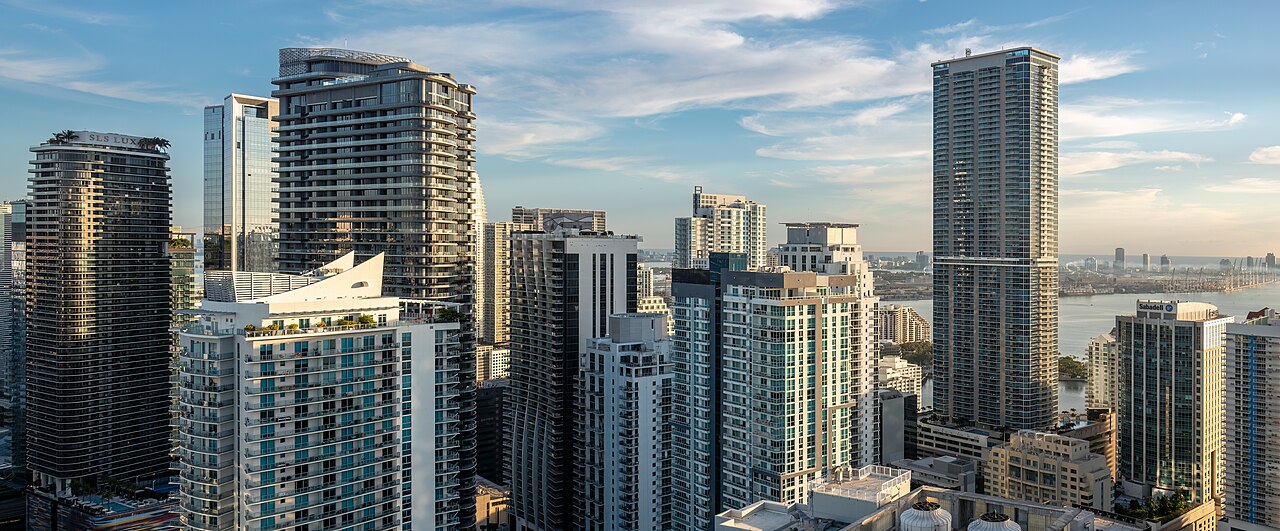
The broader economy does not move in a straight line with one company. The Bureau of Labor Statistics reported 214,900 financial-activities payroll jobs in the Miami-Fort Lauderdale-West Palm Beach metropolitan area in August 2026, a preliminary figure, down 2.7 percent from a year earlier. This category includes more than investment firms, and the geography extends well beyond Brickell. It cannot be used as Citadel’s employment count.15
It is still useful context. A prominent firm can expand while a broader industry category contracts. The two observations can coexist. Likewise, an increase in property values near a project would not, by itself, isolate the project’s effect from interest rates, other development, migration or changes in the mix of properties sold.
A more credible assessment would keep several measures apart: company employment, neighborhood commercial occupancy, city tax receipts and regional sector employment. For housing, it would follow rents and transactions over a defined area and period, with a comparison area and a transparent method. A headline valuation is not a substitute for that work.
Environmental performance needs a similarly clear boundary. Miami-Dade’s 2026 Biscayne Bay report card draws on 2025 monitoring. Its memorandum describes monthly water-quality sampling at 138 locations and annual habitat observations at 475 locations. It reports a mixed picture, including improvements in some northern areas alongside continuing nutrient concerns. That is regional evidence, not a finding about this project’s individual environmental effect.16
A waterfront development can be evaluated through its drainage approvals, construction controls, energy use and public access. Bay health requires watershed-wide measurement. Keeping those scales distinct allows the project to be judged fairly and the bay to be treated as more than scenery.
Back to report ↑08
What would make the bet work for Miami?
The strongest case for Griffin’s Miami investment is the possibility that several institutions reinforce one another. A financial headquarters can attract experienced professionals. A university can educate people and create research. Hospitals can turn research into care. Cultural institutions and public spaces can make the city a richer place to live.
Those connections are plausible, but they are not automatic. Local recruitment programs, research partnerships, accessible public facilities and dependable transport would make them tangible. Published results would make them accountable.
The next chapter should therefore be followed through milestones: verified construction progress, final public-benefit documents, completed crossings, campus approvals and enrollment, research activity and access to the institutions receiving support. Each has its own timetable and its own evidence.
Miami does not need every promise to be described as a finished transformation. It has enough substance to ask a better question: as these places open and mature, how much more can the people who live here do?
Back to report ↑People and institutions
Paul Darrah
Citadel chief workplace officer. Named source for the June occupancy plan in Bisnow’s reporting.
LinkedIn profile ↗Farnam Jahanian
Carnegie Mellon president. Leads the university announcing its planned Miami campus.
LinkedIn profile ↗
Profiles identify the people discussed. They do not indicate participation in or endorsement of this report.
Reader questions
Where is Citadel’s Miami headquarters now?+
Citadel lists 830 Brickell Plaza as its global headquarters. The future waterfront project is at 1201 Brickell Bay Drive.13
Are Citadel and Citadel Securities the same company?+
They are separate firms. Citadel is an investment firm; Citadel Securities is a market maker.2
Is the Carnegie Mellon Miami campus open?+
No. The university describes a planned campus with an approval-dependent timetable for first graduate enrollment in 2028.9
Does the $3 billion gift all go to Miami?+
The September 30 announcement allocates $2 billion to the Miami campus and $1 billion to Pittsburgh.8
Research notes
Research checked October 5, 2026. This report combines company publications, recipient announcements, public planning documents, federal statistics and attributed local reporting. It does not rely on original interviews.
Plans, proposed obligations and announced gifts are distinguished from operating facilities and measured outcomes. No multiplier, property-price premium or tourism-impact estimate is assigned to Citadel. Government packet page references use the original PDF numbering. Source notes identify the portions reviewed and the limits of verification.
Sources and reading notes
- 1.Citadel: Miami officeCurrent headquarters address and stated future office program. Undated page, checked 5 October 2026. Primary company page; reviewed.
- 2.Citadel: Who We AreCompany history and explanation of the two distinct firms. Primary company page; reviewed.
- 3.Citadel: headquarters renderings, 29 August 2024Historical design images, not confirmation of the current design or completion. Primary company publication; images downloaded and page reviewed.
- 4.Bisnow: planned headquarters occupancy, 11 June 2026Paul Darrah statements, approximately 561,000 sq ft planned occupancy and approximately 500 current employees as reported then. Secondary reporting with named company speaker; article text reviewed and archived.
- 5.Miami-Dade County: 18 December 2025 zoning packet, Z24-188Original PDF pp. 101-109, staff report; pp. 213-232, proposed declaration, including contribution conditions. Recommendations and proposed terms are not payment receipts or proof of a recorded final covenant. Primary public record; relevant pages reviewed, full 556-page packet archived.
- 6.Florida YIMBY: July 2026 shoreline submission6 July 2026 report of a 2 July filing; revised office program and public waterfront access. Secondary account of plans; reviewed and archived. Underlying July application not independently retrieved.
- 7.Bisnow: stop-work order, 21 September 2026County spokesperson Tere Florin confirms the order and safety-plan review requirement. Secondary reporting with named county confirmation; reviewed and archived. No later lifting order independently verified.
- 8.Carnegie Mellon: Griffin gift announcement, 30 September 2026Gift allocation, planned campus, leadership and approval-dependent timetable. Primary recipient announcement; reviewed and archived.
- 9.Carnegie Mellon University MiamiCampus plan and FAQ, including projected population and regulatory qualification. Checked 5 October 2026. Primary university project page; reviewed.
- 10.Baptist Health: $50 million gift, 19 March 2024Recipient announcement of neurological care and research funding. Primary recipient announcement; reviewed.
- 11.University of Miami: $50 million Sylvester gift, 5 March 2024Naming gift and research facility purpose; notes an earlier separate $50 million anonymous gift in 2020. Primary recipient announcement; reviewed.
- 12.Nicklaus Children’s: Griffin gift announcementJanuary 2023 announcement of $25 million for surgical care and hospital institutes. Primary recipient announcement; reviewed.
- 13.University of Miami: UHealth rankings and facilities, 2026Institution reports that the Griffin Cancer Research Building opened in 2025 and doubled research space. Primary institutional update; relevant facility passage reviewed.
- 14.Vizcaya: landmark gift announcement, 7 November 2025Announced $20 million gift; proposed $5 million endowment and Villa Serena arrangements distinguished from the gift. Primary recipient announcement; reviewed.
- 15.U.S. Bureau of Labor Statistics: Miami regional dataEconomy at a Glance, financial activities, August 2026: 214.9 thousand jobs, preliminary; 12-month change -2.7%. Miami-Fort Lauderdale-West Palm Beach metropolitan area. Primary statistical publication; figures subject to revision.
- 16.Miami-Dade County: 2026 Biscayne Bay report cardJune 5 board packet, PDF pp. 31-32: May 18 memorandum, using calendar-year 2025 monitoring data. Primary public record; relevant report-card memorandum reviewed and full packet archived.
- 17.Miami-Dade County: Metromover Upgrade ProjectFree service in downtown, Omni and Brickell; equipment reliability program. Primary transit agency page; reviewed and archived.
- 18.Miami-Dade County: October 2025 public hearing noticeZ2024000188; requested shoreline setback and transit-related land-use review. Hearing subsequently deferred, as confirmed by source 5. Primary legal notice; reviewed and archived.